



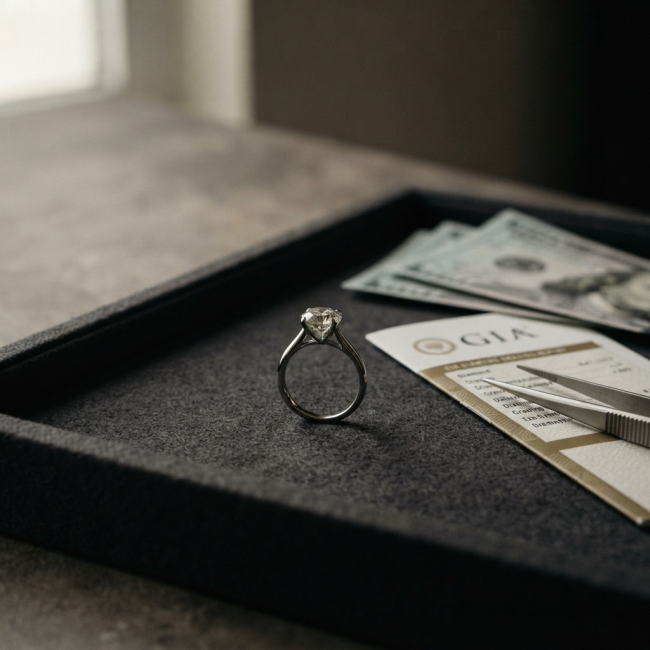
Where to Sell an Engagement Ring: 8 Options Compared
Eight places will take an engagement ring off your hands. None of them will pay the same number. On a decent stone, the gap between the best option and the worst one runs into thousands of dollars.
This is the channel-by-channel breakdown. What each option pays, how long it takes, what it quietly costs you in fees, and who it actually suits. If you want the full process instead, including paperwork, shipping, and what drives the number on your particular ring, start with our guide to how to sell an engagement ring safely and profitably.
Before any of that: your ring itself narrows the field more than most sellers expect. A 1.00ct GIA-certified round has several good homes. A half-carat uncertified stone in a tired 14K band has maybe two, and picking the wrong one costs you a bigger share of a smaller number.
IN THIS ARTICLE

THE QUICK COMPARISON
Every channel trades one thing for another. Usually speed against price, though effort and reach come into it too.
| Where You Sell | Timeline | Fees Taken Out | Suits |
|---|---|---|---|
| Specialist diamond buyer | 1–7 days | None. You're quoted a net figure | Most rings with a center stone around a carat or above |
| Local jeweler | Same day to a week | None, but pricing is built around local resale | Sellers who want a face-to-face and don't want to ship |
| Pawn shop | Same day | None, but the offer absorbs the risk | Speed above all else |
| Auction house | Weeks to months | Seller's commission, often 10–25%, plus photography and insurance | Signed pieces, rare stones, period jewelry |
| Online bidding platform | 1–3 weeks | Platform commission on the winning bid | Standard certified goods where a bid war is plausible |
| Consignment | Open-ended | Commission up to around half the sale price | Distinctive pieces and patient sellers |
| Private sale or marketplace | Unpredictable | Listing and payment processing fees | Experienced online sellers who accept the risk |
| Original retailer | Varies | Usually paid in store credit | Sellers upgrading with the same brand |
The table gets you oriented. The detail underneath it is where the money is.
SPECIALIST DIAMOND BUYERS
These are firms that buy diamonds and fine jewelry all day and resell into the trade. That's all they do. Their offers tend to hold up because they're pricing against live wholesale demand across a national or international market, instead of guessing what one shop's walk-in customers will want this month.
The process is straightforward. You send details and any grading report, you get an estimate, you ship insured, the stone gets graded in house, and a firm offer follows. Decline it and the ring comes back at no cost to you. Accept and payment goes out fast, usually by check or bank transfer.
Check a few things before you commit. Who's doing the grading and what their credentials are. Whether shipping is insured in both directions. Whether the estimate you were given is a range or a firm number. And whether anyone leans on you once the piece is in their hands, because a buyer who won't walk you through how they built an offer has usually built it badly.
A specialist isn't always the right call. A signed Art Deco piece with genuine collector appeal, or a rare fancy color, can beat any trade offer at the right auction. That category is small and most engagement rings fall outside it.
White Pine has been doing this since 2010, on both sides of the Atlantic. Send details to our diamond and jewelry buying team, or book an appointment and sell in person in NYC if you'd rather not ship at all.
LOCAL JEWELERS
Convenient and quick, and easy to misjudge in both directions.
An independent jeweler buys to put the piece in their own case, so they're pricing against one question: will someone who walks through my door buy this? If your ring is a shape and size their customers ask for, the offer can be competitive. If it isn't, they'll either pass or price defensively, because now they're carrying stock they can't move.
Chains work differently. More overhead, more process, usually a lower number, and the offer often comes back as trade-in credit instead of cash. Credit toward a new purchase always sounds better than the cash figure sitting next to it, which is exactly why they lead with it. Compare the cash numbers first, then ask yourself whether you were planning to spend that credit anyway.
PAWN SHOPS
Fastest money, lowest offer. The same counter that takes your ring takes power tools and game consoles, and the pricing has to work for a business that can move anything.
There's also a loan option, where you borrow against the ring and pay interest to get it back. Miss the terms and the ring is gone, so treat that as a separate decision with its own risk. Use a pawn shop if you need cash today and today isn't negotiable. A week of patience is usually worth several hundred dollars, sometimes considerably more.
AUCTION HOUSES
Auction is the only channel where two determined bidders can push a piece past anything the trade would pay. The appeal is real, for the right lot.
The right lot is narrow. Signed pieces from houses collectors chase, period jewelry with intact provenance, stones that are genuinely scarce. Everything else gets consigned into a general jewelry sale where it sits alongside dozens of similar rings, and the result comes down to who happened to show up.
Then there's the arithmetic. A seller's commission comes off the hammer price, often somewhere in the 10–25% band depending on the house and the estimate. Photography, cataloguing, insurance, and shipping can all be billed on top. Payment usually lands weeks after the sale closes.
The part sellers underestimate is the reserve. You and the specialist agree a floor below which the lot won't sell, and if bidding stops short of it, the piece is bought in. No sale. You've spent three or four months waiting, you may still owe the photography and cataloguing costs depending on the terms, and the ring comes back to you carrying a public record of not selling. Some houses will re-offer it in a later sale at a lower estimate. Others won't take it a second time. Set the reserve too high and this becomes a realistic outcome, which is why the specialist's estimate deserves more weight than the number you had in your head.
If a specialist buyer tells you your piece has collector appeal, an auction house is the next call. Most sellers will hear that it doesn't, and they should take that at face value.
ONLINE BIDDING PLATFORMS
A middle path that's grown a lot in the last few years. You ship the ring in, the platform has it graded, and vetted trade buyers bid over a set window. You approve or reject the top bid, and the platform takes a cut.
Competitive bidding is a real advantage on standard certified goods. Keep two things straight, though. The commission comes out of the winning bid, so the number on your screen and the number in your account are different, and you should ask for the net before agreeing to anything. And you're locked into a timeline: the ring is out of your hands for the whole window whether the bidding gets going or not.
CONSIGNMENT
You keep ownership, someone else does the selling, and you get paid whenever a buyer turns up.
Commission is the headline problem. Rates on jewelry run high, sometimes approaching half the sale price, which can leave you with less than a straight offer would have paid on day one. The open-ended timeline is the other problem, and it's the one people don't plan for. Your ring sits in someone else's case with no deadline attached to it.
Consignment suits distinctive pieces that need the right buyer to walk in, and sellers who genuinely don't care how long it takes. Read the agreement closely: who insures the piece, who covers loss or damage, and how you get it back if you change your mind.
PRIVATE SALE AND MARKETPLACES
Selling direct to another consumer skips every middleman, which is why the ceiling is higher here than anywhere else. It's also why this route goes wrong more often than any other.
The risks are specific. Payment fraud and chargebacks after the item ships. Buyers who want to meet in person to inspect a small, valuable object. Claims that the stone was swapped in transit. And the slow grind of relisting, fielding questions from people who were never going to buy, and cutting the price to get any interest at all.
If you already sell online, know how to document a shipment, and have the patience for it, the numbers can justify the trouble. For a first-time seller, the gap between a marketplace price and a firm buyer offer rarely covers what you're taking on.
BACK TO THE ORIGINAL RETAILER
Plenty of retailers advertise a buyback or upgrade program, and it's the first thing many people think of. Read the terms before you get attached to the idea.
These programs almost always pay in store credit, and most require you to trade up into something more expensive. Some only apply to diamonds bought from that retailer, with the original receipt in hand. Designer boutiques generally won't buy their own pieces back at all, even though the brand name is one of the things that makes the ring worth more on the secondary market. If you've got a designer ring, take it to a buyer who prices that premium properly, whether it's a Tiffany piece or an estate and antique ring.
WHICH OPTION FITS YOUR RING
- Center stone around 1.00ct or larger, with a GIA report. Specialist buyers and bidding platforms both compete properly for these. Get two or three quotes and take the best net figure.
- Under half a carat, no certificate. A specialist or a local jeweler. Auction and consignment won't want it.
- Signed designer, with the box and papers. Take it to a buyer who prices brand premium separately from the stone, and bring the paperwork with the ring rather than leaving it in a drawer at home. On a well-known maker the original documentation can move the offer by a meaningful percentage, and a buyer can't credit what they can't see.
- Vintage or inherited, unusual mounting. Get a specialist opinion before you assume the setting is scrap. Sometimes it's the better half of the ring.
- Lab-grown center stone. The economics here don't resemble natural at all, and our piece on lab grown versus natural resale value covers why.
- You need the money this week. Specialist buyer, or a jeweler if you won't ship. Skip anything that involves waiting on a bidder.
COMPARING OFFERS WITHOUT GETTING FOOLED
Quotes from different channels aren't comparable until you strip them back to one number: what lands in your account.
Commission, listing fees, payment processing, insurance, shipping in both directions. A winning bid with 20% coming off it can end up below a firm offer that looked worse on paper. Do that math before you're emotionally committed to the bigger headline number.
Two other habits protect you. Treat an online estimate as a range and nothing more, because the real number arrives after someone has the stone in hand and has graded it. And keep your insurance appraisal out of the comparison entirely. That document was written to reflect what replacing the ring at full retail would cost, which bears almost no relationship to resale. The factors that actually set resale value are laid out in the main guide, along with the mistakes that cost sellers the most.
Then get two or three quotes. It costs you a few days and it's the single most reliable thing you can do.
A note from our buying desk. In July a seller came to us with a 2.20ct G/VS1 round in a platinum. A chain store had already quoted her $7,000, payable as trade-in credit. Our cash offer was $10,000. Same ring, same week. The only thing that changed was who was pricing it and what they planned to do with it afterward.
Most people selling a ring have done it once. They're up against buyers who do it every day, and that asymmetry is why offers on the same stone vary so widely. Ask how the number was built. Anyone reputable will tell you.
— Bill Norton, VP of Diamond Operations, White Pine · bnorton@whitepinediamonds.com
FREQUENTLY ASKED QUESTIONS
WHAT IS THE BEST PLACE TO SELL AN ENGAGEMENT RING?
For most rings, a specialist diamond buyer gives you the best combination of price, speed, and security. They're pricing against wholesale demand across a much bigger market than any single shop serves, and there's no commission coming off the top. Auction works better for rare or collector pieces. Marketplaces have the highest ceiling and the highest risk. Which one wins depends on your ring and how quickly you need the money.
WHERE CAN I SELL AN ENGAGEMENT RING NEAR ME?
Local options are jewelers, estate buyers, and pawn shops. All three price around what they can resell in their own market, which caps what they can pay. If you're in or near New York, you can book an appointment and sell diamonds and jewelry in NYC in person, which gets you specialist pricing without shipping anything.
CAN I SELL AN ENGAGEMENT RING WITHOUT THE CERTIFICATE?
Yes. Uncertified stones sell every day. A certificate removes uncertainty for the buyer, so having one generally helps the offer, and it's worth a proper search through your paperwork before you assume it's gone. Don't pay to recertify on your own initiative, though. It takes time, and a borderline stone can come back with a grade you weren't expecting.
SHOULD I SELL THE DIAMOND SEPARATELY FROM THE SETTING?
Usually not. A competent buyer values the stone and the metal separately anyway, so pulling the ring apart gains you nothing and adds the risk of damage during removal. The exception is a designer mounting worth more intact than the metal in it. Ask first.
IS IT SAFE TO SHIP A RING TO AN ONLINE BUYER?
With a reputable buyer, yes. Shipping should be insured and tracked, arranged or paid for by the buyer, and the return leg should be insured too if you decline the offer. If a buyer can't explain their shipping and insurance arrangements in plain terms, don't send them anything.
HOW LONG DOES EACH OPTION TAKE TO PAY OUT?
A specialist buyer typically runs one to seven days from quote to payment. A jeweler or pawn shop can be same-day. Bidding platforms take one to three weeks including the auction window. Auction and consignment run weeks to months, and neither guarantees a sale at all.
GET A REAL NUMBER ON YOUR RING
Diamonds and fine jewelry are the only thing we buy. Every offer comes from someone who watches this market daily.
Send your ring details through the short form and we'll come back within one business day. Shipping is fully insured both ways, and if you don't like the offer, the ring goes home at no cost to you.
Read next:Sell Your Engagement Ring Online — How To Sell Safely And Profitably. The full guide covers documentation, the step-by-step process, what drives your offer, and the mistakes that cost sellers the most money.