


DO DIAMOND BUYERS PURCHASE LAB-GROWN DIAMONDS?
Most professional diamond buyers don't purchase lab-grown diamonds. We're one of them.
Our buying desk has made offers on natural polished goods only since we opened in 2010. The question still comes up constantly, from two directions: people trying to sell a lab-grown engagement ring, and jewelers who need to tell a customer something. It has come up more this year than last. Lab-grown wholesale prices have kept falling, so the distance between what someone paid in 2021 and what anyone will pay them now has widened to the point where the conversation is genuinely uncomfortable. Below is the reasoning from the buy side, what a lab-grown stone realistically fetches on resale, and what to do with one if you own it.
KEY TAKEAWAYS

Short answer: most professional diamond buyers, White Pine included, do not purchase lab-grown diamonds. Wholesale lab-grown prices fall faster than a buyer can turn the inventory over.
- White Pine buys natural polished diamonds only: loose stones, melee, estate and fine jewelry, scrap gold. No offers on rough, uncut or lab-grown material.
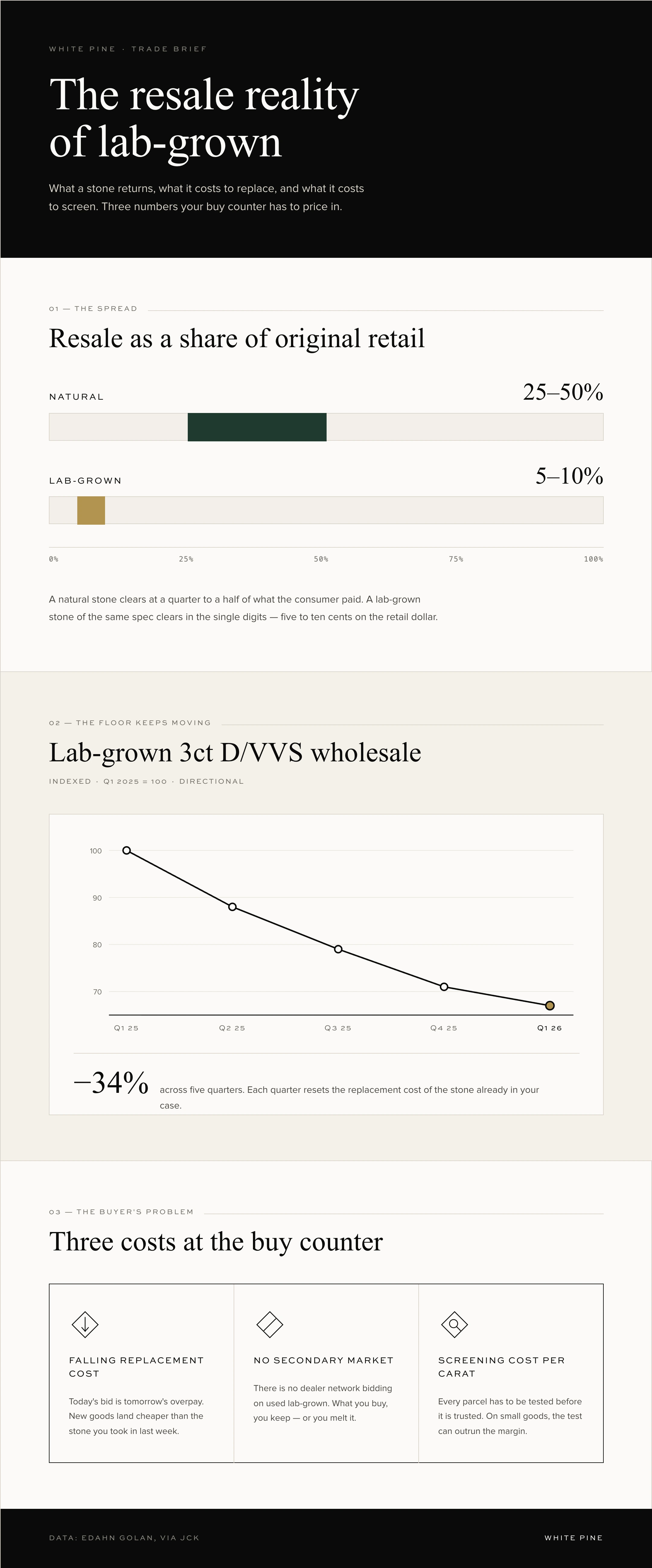
- Lab-grown wholesale prices keep falling. A 3-carat D/VVS round traded near $126 per carat in Q1 2026, roughly 30% below the year before.
- Lab-grown resale runs 5–10% of original retail, against roughly 25–50% for a comparable natural diamond sold through a specialist.
- We sell lab-grown melee and jewelry essentials to the trade while buying natural goods only. The two positions come from the same piece of arithmetic.
Get a free diamond valuation · Reviewed by Matthew Cacioppo, Vice President · Updated August 2026
ALMOST NOBODY BUYS LAB-GROWN SECONDHAND
The dealers and recyclers who buy previously owned stones and put them back into circulation have almost all landed in the same place. Some decline to quote at all. Others quote a number that surprises the seller badly enough that they walk out.
Our policy is published rather than decided case by case, which we think is the fairer way to do it. We buy natural polished diamonds: loose stones with or without certificates, melee, gold and diamond jewelry, estate pieces, and scrap gold. Rough, uncut and lab-grown goods get no offer.
One exception is worth knowing about. Some retailers run trade-up programs on stones they originally sold, and those are store credits, not purchases, usually valid only if you spend more than you did the first time.
WHY DIAMOND BUYERS DON'T PURCHASE LAB-GROWN DIAMONDS
THE REPLACEMENT COST KEEPS MOVING
A buyer earns the gap between what they pay you and what the stone eventually sells for. That arithmetic falls apart when a brand-new equivalent gets cheaper while the stone you bought sits in a safe waiting for a home.
And it does get cheaper, reliably. Wholesale prices for loose lab-grown diamonds fell another 14% year over year in Q1 2026, with a 3-carat VVS D round landing near $126 per carat, around 30% off the 2025 figure. A stone bought this morning can be worth less by the time it reaches a showcase.
Natural diamonds behave differently. Supply is finite, the price references have decades of history behind them, and a recut stone re-enters a market that already knows what it's worth.
EVERY BUYER NEEDS AN EXIT
For natural goods, ours is deep. Melee assortments, certified singles, estate jewelry, recutting, remanufacturing: there are half a dozen places a natural stone can go, and most weeks it goes to more than one of them.
For lab-grown, that network barely exists. Auction houses won't take them. Any dealer who wants calibrated melee can order it new for less than a used parcel costs to sort, so there's no reason to buy the used parcel.
SCREENING COSTS THE SAME EITHER WAY
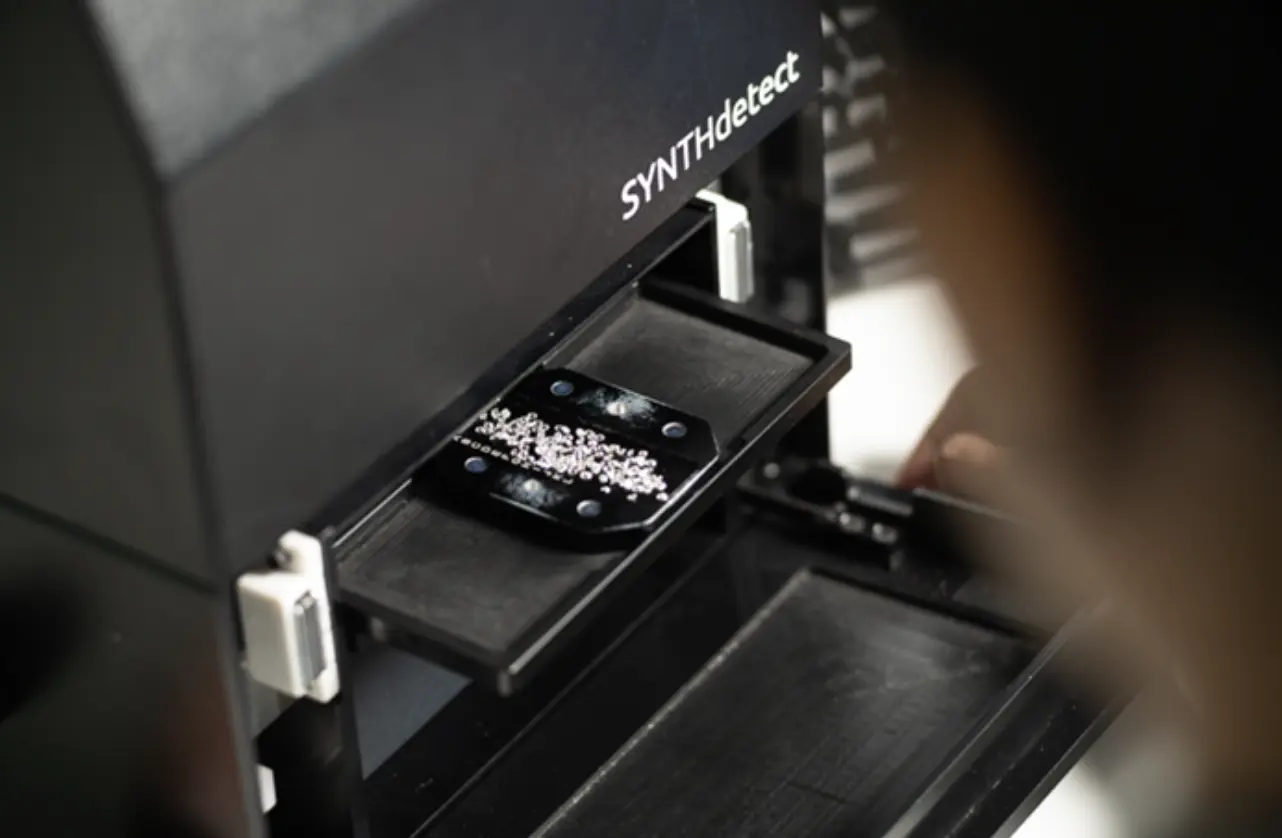
Every parcel that arrives at our office is tested on De Beers screening equipment before anything else happens to it, because a single undisclosed lab-grown stone sitting in a natural parcel is a serious problem for whoever owns it next. On natural goods that expense pays for itself several times over. On lab-grown, the sorting costs more than the stones are worth.
THE CONVERSATION NOBODY WANTS
Retail lab-grown prices have more than halved since 2021. A seller who paid full retail then gets an offer today that reads as an insult rather than a market price. It isn't one, but saying so takes twenty minutes and almost never ends with the customer happier than when they walked in. Plenty of jewelers decide the relationship is worth more than the transaction and simply don't start.
WHAT A LAB-GROWN DIAMOND IS WORTH ON RESALE
NATURAL
Resale, % of retail: 25–50%
New-equivalent price trend: broadly stable
Certification: GIA report, with an established price reference
LAB-GROWN
Resale, % of retail: 5–10%, often less
New-equivalent price trend: falling 10–20% a year
Certification: GIA LGDR, no price reference
The line in that comparison that does the most work is the middle one. Selling a used lab-grown diamond means competing with a cheaper new one, which is never true of a natural stone.
WHAT WE SELL, AND WHAT WE BUY
We do sell lab-grown. Lab-grown melee sits alongside our natural recycled stones, and we run a made-to-order Lab-Grown Diamond Essentials range built for short lead times.
We don't buy it. Both positions come out of the same fact: manufactured goods are cheap to produce new, which makes them good to sell and poor to buy back. Our buying business runs instead on recycled natural diamonds, which we screen, sort, recut to GIA standards and return to the market.

HOW TO SELL A LAB-GROWN DIAMOND
FIND THE GRADING REPORT
An LGDR or IGI report, plus the inscription on the girdle, confirms what you actually have.
VALUE THE METAL SEPARATELY
On a lot of rings the gold or platinum is worth more than the stone. Ask for it quoted on its own line.
CHECK WHERE YOU BOUGHT IT
A trade-up credit is usually the best number on the table. Read the upgrade conditions before you commit to anything.
TRY SELLING PRIVATELY FIRST
Someone buying it to wear will pay closer to retail than any dealer can.
SEPARATE ANY NATURAL STONES
Side stones, melee and a natural center all sell on their own merits.
If you're a jeweler, the fix sits upstream of all six of these. Set the resale expectation at the point of sale, and don't appraise lab-grown against natural comparables. The 2021 numbers are long gone.
FREQUENTLY ASKED QUESTIONS
DO DIAMOND BUYERS PURCHASE LAB-GROWN DIAMONDS?
Most do not. Professional buyers, White Pine included, purchase natural polished diamonds only, because lab-grown wholesale prices fall roughly 10–20% a year and a buyer risks losing money before the stone sells. A few retailers offer trade-up credits instead.
HOW MUCH IS MY LAB-GROWN DIAMOND WORTH IF I SELL IT?
Realistically 5–10% of what you paid, often less, because the stone competes with a cheaper new equivalent. On many rings the setting metal makes up most of the offer, so ask for it quoted separately.
WILL A PAWN SHOP BUY A LAB-GROWN DIAMOND?
Some will, most won't, and offers are typically scrap-level. Pawnbrokers lend against collateral value, and a fast-depreciating stone makes poor collateral. Bring the grading report and expect the metal to drive the offer.
DOES WHITE PINE BUY LAB-GROWN DIAMONDS?
No. We purchase natural polished diamonds, melee, diamond and gold jewelry, estate jewelry and scrap gold. Rough, uncut and lab-grown material is excluded, though we do sell lab-grown melee and jewelry essentials to trade customers.
ARE RECYCLED NATURAL DIAMONDS A BETTER RESALE BET?
Yes. Recycled natural diamonds are graded on the same scale as newly mined stones and trade against the same price references, so they hold value the way manufactured goods can't, while avoiding new mining.
FINAL THOUGHTS
None of this makes a lab-grown diamond a bad thing to own. It's a real diamond, graded on the same scale, and you paid a fraction of what the natural equivalent would have cost. The mistake is only in the resale math.
If what you have is natural, whether that's a loose stone, a parcel of melee, or a ring that came down through the family, that market is active and we are buying. Request a valuation from our New York office, or book a selling appointment in Birmingham. No fees or commissions, and we ship back anything you decide not to sell.