




HOW TO TELL IF YOUR TIFFANY PIECE IS AUTHENTIC BEFORE YOU SELL
Most Tiffany pieces that come across our desk are exactly what the seller says they are. Some aren't. And then there's the middle ground: a genuine Tiffany mounting holding a diamond Tiffany never set, or a real Tiffany chain wearing a tag that came from somewhere else.
It matters more than people think. Once a piece is confirmed as Tiffany, we price it against other Tiffany jewelry, and Tiffany sells for a lot more than unbranded jewelry. If the signature doesn't hold up, the piece gets priced like any other gold, silver or diamond jewelry.
You can check a lot of this yourself before you ship anything. The hallmark, the serial number, the inscription on the diamond, the certificate and the box each tell you something. None of them settles it alone. We authenticate every Tiffany piece in-house at White Pine before we make an offer, and the checks below are the same ones we run. If you already know what you have and want to know how the sale itself works, our guide to selling Tiffany jewelry covers where to sell, what drives the price and what to avoid.
IN THIS GUIDE

CHECK THE HALLMARK FIRST
On a ring, look inside the shank, usually toward the bottom. On a bracelet or necklace the mark is on the clasp, a jump ring, or a small tag near the clasp. Earrings are often marked on the post or the back.
A genuine Tiffany mark reads "Tiffany & Co." or "T & Co." next to a metal mark. That's it. A misspelling, "Tiffany's" with an apostrophe, or an extra word squeezed into the stamp is a problem on its own, before you look at anything else.
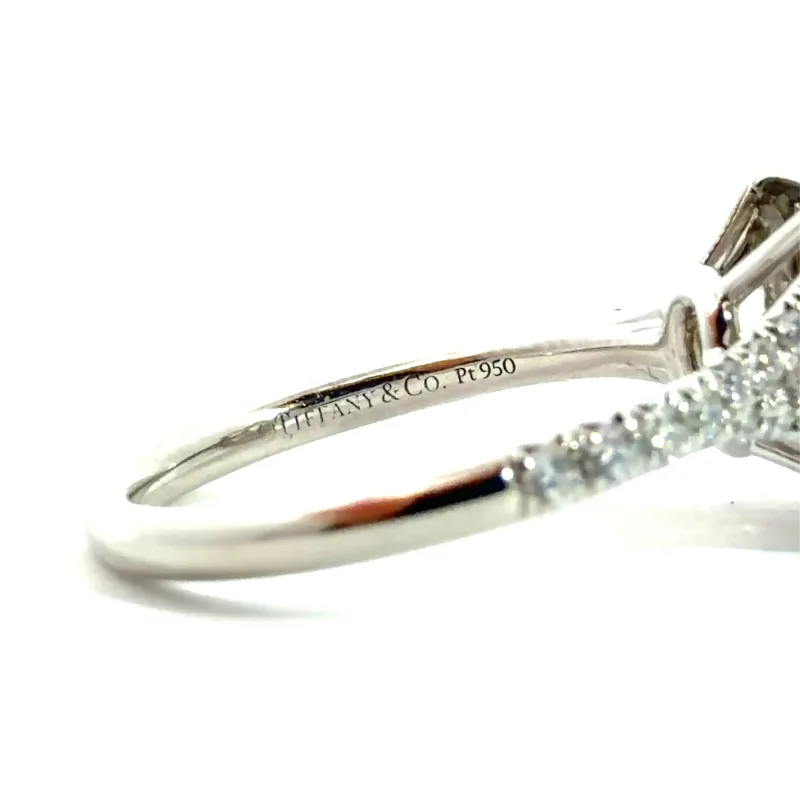
Inside the shank of a Tiffany engagement ring: the © Tiffany & Co. signature and Pt950 for platinum. Clean, evenly spaced, the same depth from end to end.
| Metal | What the mark usually reads | Worth knowing |
|---|---|---|
| Sterling silver | 925 or Sterling, with Tiffany & Co. or T & Co. | Where most Tiffany fakes live. Counterfeits carry a 925 too, so the stamp alone proves nothing. |
| 18K gold | 750, sometimes AU750. Older American pieces may read 18K. | Look at edges and the inside of the shank. Plating wears through there first. |
| Platinum | PT950 or 950 | Noticeably heavier than gold in the same size. A platinum-stamped ring that feels light deserves a test. |
| Rubedo | "metal" | Tiffany's own rose-toned alloy. A Rubedo piece stamped 750 or 925 is worth a closer look. |
| Designer collections | Designer name (Elsa Peretti, Paloma Picasso, Schlumberger), often with a © and Tiffany & Co. | A year in the stamp usually refers to the design's copyright. Don't read it as the date your piece was made. |
WHAT A BAD STAMP LOOKS LIKE
Under a 10x loupe, a genuine Tiffany stamp is crisp and evenly spaced and sits at the same depth from the first letter to the last. Fakes tend to show shallow or uneven lettering, letters that drift off a straight line, and a font that's slightly wrong in a way you notice once you've seen the real one. Edges matter too. Tiffany's marks have clean, sharp edges. A soft, rounded impression is a warning sign.
Wear complicates this. A ring worn every day for forty years can have its hallmark polished half away, and that's normal. A piece that looks brand new with a mushy stamp isn't.
SERIAL NUMBERS ON THE BAND
Tiffany has stamped identifying numbers on its rings for a long time, but what the number refers to has changed. On many older rings, the band carries the diamond's registration number, usually a letter followed by digits, stamped beside the metal mark and the carat weight. Something like PT950, a number, and .57CT. From the early 2000s Tiffany moved to individual ring serial numbers, which settled into an eight-digit format. By around 2004, engagement rings were numbered as standard, with the number tied to the ring's certificate and to Tiffany's own records.
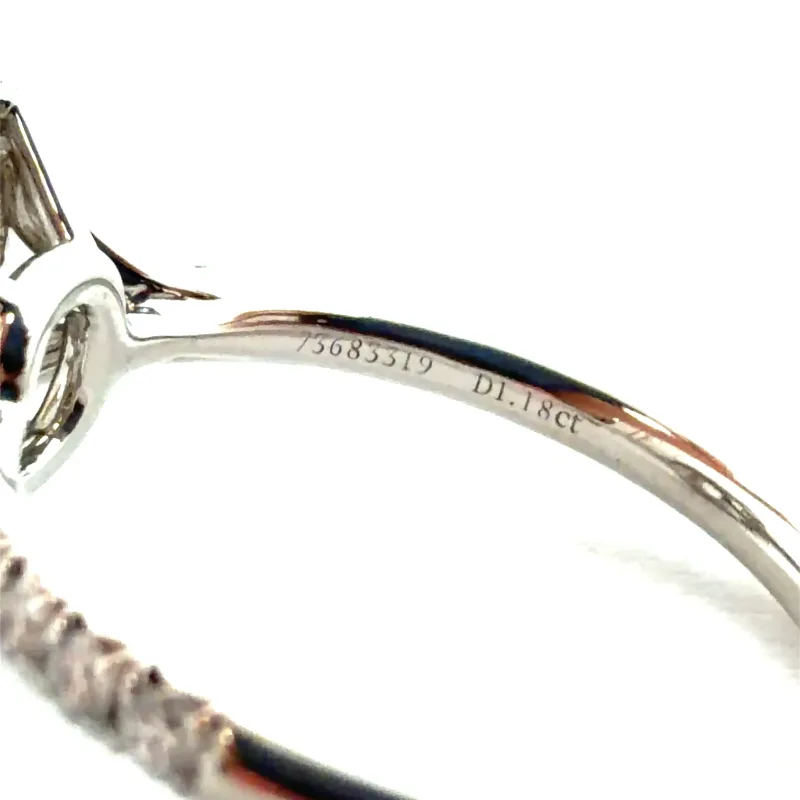
The other side of the same shank. 73683319 is the ring's serial number, and D1.18ct gives the center diamond's weight, 1.18 carats.
So a missing number on a Tiffany ring tells you something about its age before it tells you anything about whether it's real. A 1990s solitaire with no serial can be perfectly genuine. A ring that looks like a current Tiffany Setting with no number at all needs a closer look.
Whatever's on the band should match the paperwork exactly. On a newer ring, the certificate prints the ring serial and the diamond's number together. The ring in these photos reads 73683319 on the band, and its certificate's registration number reads 73683319/X10260427. Ring serial first, diamond number second. And a number that's been filed down, polished out or restamped worries us more than a number that was never there.
THE LASER INSCRIPTION ON THE DIAMOND
On a diamond ring, this is one of the strongest checks there is. Most sellers have never heard of it.
From the mid-2000s on, Tiffany has laser-inscribed its diamonds with "T&Co." followed by the diamond's registration number. Most labs put inscriptions on the girdle, the thin outer edge of the stone, so that's where people look first. Tiffany's certificate has a line for each, Crown and Girdle, and on many newer Tiffany diamonds the inscription is on the crown, the top of the stone. The certificate pictured further down reads T&Co.X10260427 on the crown and none on the girdle. That diamond number is different from the serial on the band. Don't let that throw you. The band and the stone don't have to match each other. Each one has to match the certificate.
Some Tiffany diamonds from around 2004 and earlier were never inscribed. They'll still have a registration number on the certificate, just nothing on the stone. So no inscription on an older ring isn't a red flag by itself. No inscription on a ring that's clearly recent is.
You almost certainly won't read it with a standard 10x loupe. A crown inscription is made to be invisible to the eye and hard to find even under magnification, and a girdle inscription can hide partly under a prong. It takes a gemological microscope and someone who knows where to look.
Why go to the trouble? Because the inscription is what catches a genuine Tiffany band holding the wrong diamond. Stones get replaced after a chip. They get swapped on purpose. The band still says Tiffany and the stone doesn't. Tiffany sells natural diamonds and says so in its certificate commitment, so if the center stone tests as lab-grown, it isn't the stone Tiffany sold.
What the inscription won't tell you is the grade. It ties the stone to Tiffany's records. The color and clarity Tiffany assigned to it live on the Diamond Certificate or a Tiffany appraisal, and without one of those, we're grading the stone ourselves.
Some Tiffany diamonds also came with a GIA report. If yours did, look the number up on GIA Report Check and make sure the weight, color and clarity line up with the Tiffany paperwork. GIA (gold standard) inscribes its own report number on the girdle too, so a stone can carry both.
THE TIFFANY DIAMOND CERTIFICATE
This is the piece of paper that matters. The certificate records the principal diamond: shape, carat weight, and Tiffany's own color and clarity grades. On newer certificates the ring serial and the inscription number sit near the top. The format has changed over the years. Older ones were laminated. They've come in a blue paper wallet or a black leather-look folder, and the certificate itself typically carries an embossed Tiffany stamp you can feel with a fingertip.
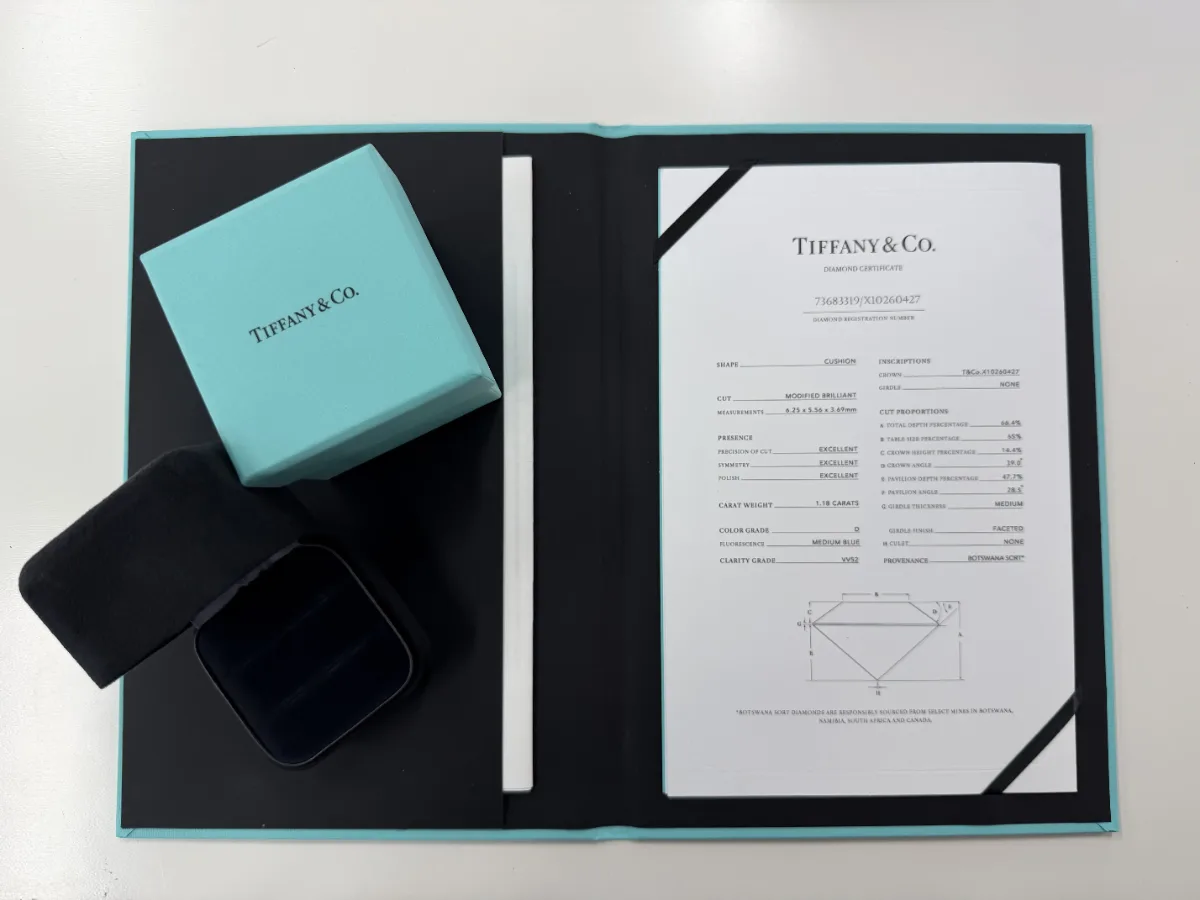
The certificate for the ring above. The registration number at the top, 73683319/X10260427, pairs the ring serial with the diamond number, and the inscriptions line shows T&Co.X10260427 on the crown.
Tiffany describes the certificate as its guarantee of the diamond's authenticity and grades. Read the commitment that goes with it, though, and it's written to the original purchaser. For a second owner, the certificate works as the record of Tiffany's grade and the link between one specific stone and one specific ring. Lose it and the price moves. In our pricing, a Tiffany diamond piece without its diamond report can come in 10% to 20% lower than the same piece with it.
A fake certificate is a lot easier to make than a fake inscription. Wrong fonts, crooked spacing, no emboss, a number that doesn't match the stone. Check the certificate against the diamond, never just against itself.
Plenty of Tiffany rings also came with a retail replacement valuation. That's an insurance figure. It tells you what it would cost to replace the ring at a Tiffany counter, and it has very little to do with what the ring sells for. Anyone can put a value on a stone. Only a buyer putting money down gives you a real number.
THE BLUE BOX, POUCH AND RECEIPT
The Blue Box is the thing sellers worry about most, and it matters the least. Empty Tiffany boxes, pouches and shopping bags sell online every day, and counterfeit packaging is good enough now to fool people who've owned the real thing. So it proves very little, and a missing box doesn't move our offer in any significant way. We look at the jewelry.
Send it if you have it. Don't go hunting for a replacement box. The paperwork worth digging out is the Diamond Certificate on anything with a diamond, and the original receipt from a Tiffany store with the item described on it. Keep those with the piece.
Lost some or all of it? Read our guide to selling Tiffany jewelry without box or papers.
TIFFANY SILVER: RETURN TO TIFFANY, PERETTI AND THE REST
We buy Tiffany silver. It's also where most of the fakes are. Return to Tiffany bracelets top the list, with heart tag necklaces and Elsa Peretti Open Hearts close behind, because everyone knows what they look like.
Start with weight. Real Tiffany sterling has some heft, and a lot of fakes are plated base metal that feels light in the hand. Then look at the engraving on any tag. The lettering should be clean, evenly spaced and centered. Wobbly letters, or text that crowds one edge of the tag, are a problem. Clasps and jump rings are often marked as well, and a flimsy clasp on an otherwise heavy chain is a giveaway.
Color tells you something too. Real sterling tarnishes. It goes gray, then close to black, and it polishes back. Plating that's worn through to a coppery or yellowish base underneath doesn't polish back. Sterling never shows a different metal underneath.
And yes, a fake can be stamped 925. Some counterfeits are even made in real sterling. So a piece passing a metal test is a start. It doesn't make it Tiffany.
WHAT TIFFANY WILL AND WON'T TELL YOU
People assume they can walk into a Tiffany store and get a yes or no. In our experience it doesn't usually work that way for a piece bought secondhand. Tiffany will service and clean its jewelry, and a store can pull records on some pieces. But it doesn't generally hand a written authentication to someone who isn't the original buyer. Sellers who've tried tell us about paying for an evaluation, waiting weeks, and coming away without a straight answer.
If you are the original purchaser, with a receipt in your name, it's a different conversation. Use it.
HOW WE AUTHENTICATE AT WHITE PINE
We do it in-house, on every Tiffany piece, before we make an offer. Hallmarks go under magnification. Diamonds get tested and checked under the microscope for the inscription, and we match the inscription and the band number to whatever paperwork you send. The metal gets tested. Then there's the part you can't put on a checklist, which is how the piece is built. The prong work, the finish inside the shank, the way a clasp closes. When you handle a lot of Tiffany, you notice when something's off.
If something doesn't check out, we tell you what we found and why. You're not stuck. Shipping is free and fully insured both ways, so if you decide not to sell, the piece comes back to you at no cost.
When you request a Tiffany quote, send photos of the hallmark, the band number and every page of the certificate. It speeds things up, and it means the estimate is built on your actual piece.
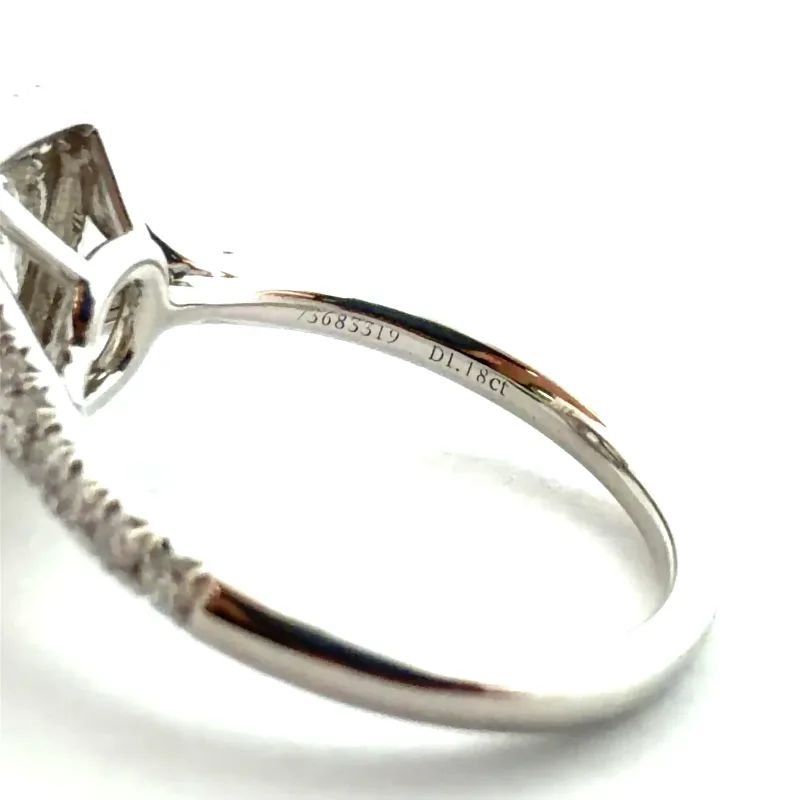
The kind of photo that helps: the band stamp shot close and in focus, so we can read the serial and carat weight before the ring ever ships.
If you're not in a hurry to sell, timing can matter as well. Our guide to maximizing Tiffany resale value covers when demand tends to be strongest.
WHITE PINE'S TAKE — BILL NORTON
The Tiffany signature changes what I compare a piece to when I price it. Tiffany jewelry sells at a much higher price than regular, unbranded jewelry, so once a piece is confirmed as genuine, the comparisons I use are other Tiffany pieces. That's why authentication comes first.
Most of the fakes I see are Tiffany silver. Return to Tiffany bracelets, mostly, and similar silver pieces.
Don't worry about the box. A missing box isn't significant. A missing diamond report is. On a diamond piece it can lower the price by 10% to 20%. The laser inscription on the diamond helps authenticate it, but it doesn't tell me Tiffany's grade. I only know that from the Diamond Report or a Tiffany appraisal.
And go in with the right expectations. If you're selling for immediate payment, Tiffany owners can expect 25% to 40% of the Tiffany retail price. Your own piece could land anywhere in that range or outside it, and the offer is the only number that counts.
If you want to talk through a piece before you send it, email or call me.
Bill Norton
VP of Diamond Operations, White Pine
bnorton@whitepinediamonds.com | +1 646 758 0281
FREQUENTLY ASKED QUESTIONS
DOES EVERY GENUINE TIFFANY PIECE HAVE A SERIAL NUMBER?
No. Individual serials became standard on engagement rings in the mid-2000s. Older rings, and most non-bridal pieces like silver bracelets and pendants, don't carry one. They should still carry the Tiffany & Co. or T & Co. mark and a metal mark.
CAN I READ THE LASER INSCRIPTION ON MY DIAMOND MYSELF?
Usually not with a standard loupe. It's microscopic. On many newer Tiffany diamonds it's on the crown, and on others it's on the girdle, sometimes partly under a prong. A jeweler with a gemological microscope can read it in a couple of minutes, and we check it on every Tiffany diamond we look at. It confirms the stone is Tiffany's. It doesn't tell you the grade.
IS A 925 STAMP PROOF THAT TIFFANY SILVER IS REAL?
No. It's a claim about metal purity, and counterfeiters stamp it too. Real Tiffany silver needs the correct Tiffany mark, the right weight, clean engraving and solid construction.
WILL YOU BUY MY TIFFANY PIECE WITHOUT THE BOX OR CERTIFICATE?
Yes. We authenticate the jewelry itself. A missing box makes no significant difference to the offer. On a diamond piece, a missing Diamond Certificate can bring the price down by 10% to 20%, because without it we don't know Tiffany's grade.
WHAT IF MY DIAMOND ISN'T THE ORIGINAL TIFFANY STONE?
We'll usually still make an offer. The ring gets valued as a Tiffany mounting with a diamond priced on its own grades. It's worth knowing before you sell, so you're not surprised by an offer that treats it differently from a fully original piece.
Send us the photos. We'll tell you what you've got.