



HOW DIAMOND BUYERS CALCULATE YOUR OFFER (AND WHY TWO QUOTES CAN BE THOUSANDS APART)
Any diamond offer starts with the trade price for that grade of stone, and that price moves week to week. How diamond buyers calculate offers from there comes down to judgment calls, and most buyers won't walk you through theirs.
So two buyers can look at the same engagement ring and come back thousands of dollars apart, and the higher number isn't always the better one. Mostly the gap comes from what each buyer plans to do with the stone next.
KEY TAKEAWAYS
Short answer: Diamond buyers calculate offers from a wholesale trade benchmark, adjusted for grading risk and for how they plan to resell the stone, which is why quotes vary.
- Starting point: Diamond buyers, White Pine included, typically start from the Rapaport Price List and adjust for market trends and supply.
- Grading risk: An uncertified diamond tends to draw lower early offers than a GIA-graded stone.
- Appraisals: Insurance appraisals show retail replacement cost, so diamond offers land well below them.
- Comparing quotes: Compare what you'd actually be paid, and be wary of a photo estimate far above the rest.
- Where to sell: a specialist such as White Pine Diamonds, which deducts no fees from its offers.
Reviewed by Bill Norton, VP Diamond Operations · Updated November 2026
HOW DIAMOND BUYERS CALCULATE OFFERS
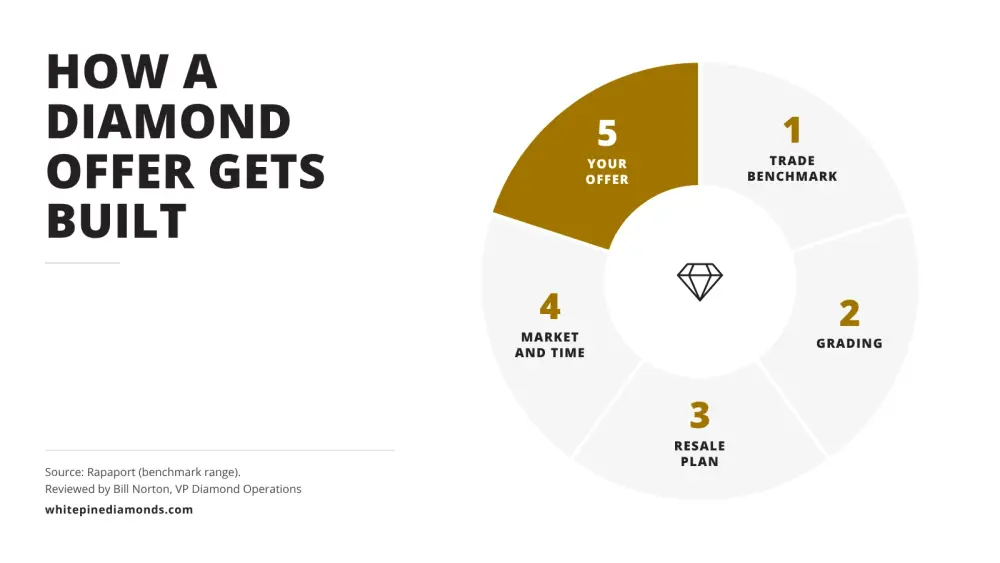
We start from the Rapaport Price List, same as most dealers. It's weekly asking prices by shape, carat, color and clarity, and Rapaport's own site says most diamonds trade 10–30% under it. Then the adjustments start:

"Rap gives us an idea of what the wholesale list price is, and we do use it as a starting point. We also consider market trends, our supply, time needed to sell the diamond or jewelry, and how it fits with our sales outlets."
Bill Norton, VP Diamond Operations, White Pine
GRADING, AND WHAT THE GRADE LEAVES OUT
The GIA 4Cs (carat, color, clarity and cut) get a stone into a price bracket. Plenty moves it around inside that bracket. Proportions matter on rounds. Strong fluorescence can cost a high-color stone. Then there's damage, most often a chip on the girdle, the thin outer edge the prongs hold.
A lab report settles most of this up front. Without one, the buyer's estimating, and estimates run low until the stone's under a scope. We also test every stone, since White Pine only buys natural diamonds. (On the trade side we sell natural & lab-grown melee, tested and kept strictly apart.)
WHERE THE STONE GOES NEXT
Whoever buys your diamond has to sell it again, and that plan caps what they'll pay. A well-cut certified stone can go straight back out to a dealer. A chipped one probably gets recut, which loses weight and takes weeks. Estate jewelry often sells better whole.
If one buyer has a customer waiting for an old European cut and another plans to recut it, the first can pay more for the same stone.
WHY TWO DIAMOND QUOTES CAN BE THOUSANDS APART
Two other things widen the gap.
- An inflated photo estimate. Some buyers quote high from photos to get your piece in the mail, then cut the price once it arrives.
- A middleman in the chain. Plenty of local shops resell to wholesalers, so their offer leaves room for somebody else's margin.
| Selling route | When you're paid | What comes off the top |
|---|---|---|
| Local jeweler or gold buyer | Usually on the spot | Built into the offer |
| Specialist diamond buyer | Once you accept | Varies, so ask (White Pine deducts none) |
| Consignment | After the piece sells | Commission on the sale price |
| Auction | After the sale settles | Seller's commission and fees |
WHAT OUR BUYERS CHECK BEFORE MAKING AN OFFER
Our buyers are GIA-trained, and bigger pieces go to Bill, a GIA Diamond Grading Graduate who's been with White Pine since 2010. From photos we usually give an estimate range the same day. Bill is blunt about that range:
"We give you an honest range, including a low end that will account for any discrepancies in the grading (if not GIA certified). We are not interested in wasting your time."
Bill Norton, VP Diamond Operations, White Pine
Once the piece arrives, we grade it in hand, normally the next business day, and confirm or adjust the figure. Plain settings are valued at roughly their metal content.
According to Bill, most sellers never factor in fees. We don't charge any. "Our estimate, or final price, is the amount you will be paid," he says. "There are no additional fees deducted from your offer."
HOW TO COMPARE DIAMOND BUYER OFFERS
- Gather your GIA report number, appraisals, receipts, and any box and papers.
- Look the report up on GIA Report Check. It's free.
- Photograph the piece on a white background from two angles, plus the certificate front and back.
- Get two or three quotes, and ask each buyer whether it's an estimate or a firm offer.
- Ask what you'll walk away with after fees, and what it costs to get the piece back if you say no.
- Don't take the stone out of the setting yourself.
FREQUENTLY ASKED QUESTIONS
WHY IS A DIAMOND BUYER'S OFFER LOWER THAN MY APPRAISAL?
Most appraisals are written for insurance. They show what it would cost to replace your piece at retail. A diamond buyer pays wholesale, because they've got to resell the stone. Holding an offer up against an appraisal is like comparing a trade-in value to the sticker price.
DO DIAMOND BUYERS USE THE RAPAPORT PRICE LIST?
Many do, us included. The Rapaport Price List gives weekly benchmark asking prices by shape, size, color and clarity, but most diamonds trade below it. Buyers then adjust for condition, market trends and how quickly they can resell. The list alone won't tell you what your diamond is worth.
DOES A GIA CERTIFICATE RAISE A DIAMOND OFFER?
Mostly it makes the offer firmer. With a GIA report, the buyer prices from a known grade instead of guessing. Uncertified stones still sell, but early estimates on them tend to be cautious until the buyer has graded the stone in hand.
SHOULD I TAKE MY DIAMOND OUT OF ITS SETTING BEFORE SELLING?
No. It's easy to chip the girdle or scratch the metal without the right tools, and any damage comes off your offer. A decent buyer can unset it. And if the setting is signed or antique, it may be worth something on its own, which you'd lose by treating it as scrap.
HOW MANY DIAMOND QUOTES SHOULD I GET?
Two or three is usually enough. Past that you're mostly adding time. Compare the same kind of number from each buyer, the amount you'd actually be paid, and be skeptical of any estimate that sits far above the others. It may not survive the in-hand inspection.
GETTING YOUR FIRST NUMBER
Send the same photos and paperwork to a couple of buyers. To include White Pine, request a free estimate on our diamond buyers page. We'll send a fully insured label, and if you turn down the in-hand offer, the piece comes back insured at no cost.