



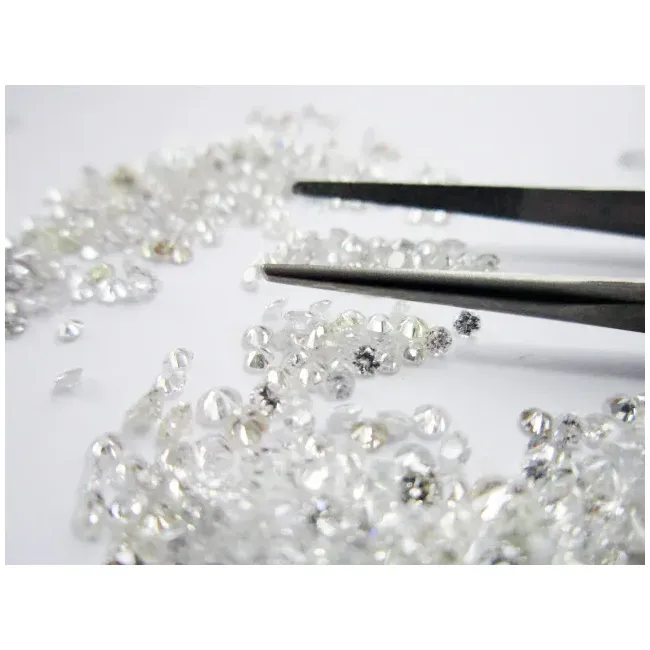
WHICH MELEE DIAMOND SHAPES ARE POPULAR IN JEWELRY PRODUCTION?
Melee diamonds are the unsung heroes of fine jewelry — the small accent stones that add sparkle, depth, and dimension to everything from pavé engagement rings to eternity bands. They come in a wide variety of shapes, each with its own aesthetic character and practical considerations. Whether you're a jeweler sourcing inventory or a designer planning a custom piece, understanding the differences between melee shapes can make a meaningful difference in your final result.
COMMONLY USED MELEE DIAMOND SHAPES

ROUND MELEE DIAMONDS
The most widely used melee shape in jewelry production. Round melee are the go-to choice for pavé and halo settings and are commonly featured along engagement ring bands. Their symmetrical brilliance makes them easy to match and highly versatile across design styles — traditional or contemporary.
PRINCESS CUT MELEE
Square in shape — not rectangular — princess cut melee require that table size and depth are closely matched for a uniform appearance. They start at 1.5mm and are available in a range of sizes. Their clean geometric lines make them a popular choice for modern and architectural jewelry designs.
TAPERED BAGUETTE MELEE
With their distinctive trapezoid shape, tapered baguettes are ideal for curved settings and three-stone designs. Their elongated form adds a sleek, step-cut elegance. The main challenge is matching — their wide variation in exact shape and size makes finding well-matched pairs more demanding than with rounds.
OVAL MELEE
Oval melee have grown increasingly popular, particularly in eternity bands. When cut well, they display excellent brilliance with minimal bowtie reflections. The primary challenge with oval melee is outline matching — ensuring that the length-to-width ratio and curvature are consistent across all stones in a setting.
PEAR-SHAPED MELEE
Pear melee combine the brilliance of a round with the elegant point of a marquise. Like ovals, finding a consistent outline is critical — width, length, and curve profiles must align. Minimal bowtie reflections are also important to check for when sourcing pear-shaped melee for matched settings.
MARQUISE MELEE
Marquise melee are available in various sizes and look particularly striking in eternity bands where their elongated form creates a continuous, flowing line. When sourcing marquise melee, inspect carefully for chips at the pointed tips and check for minimal bowtie reflections to ensure consistent visual quality across the setting.
OTHER SHAPES
Beyond the shapes above, melee diamonds are also available in emerald cut, straight baguette, and trillion cut. Each brings its own distinctive character to a piece and can be used to create bold, geometric designs or add unique textural contrast alongside round melee.
SOURCE PRECISION-MATCHED MELEE FROM WHITE PINE
White Pine offers an exceptional assortment of melee diamond shapes, sizes, colors, and clarities — all at highly competitive wholesale prices. Our recycled melee are rigorously tested, expertly sorted, and precisely matched, giving you the confidence that every stone in your setting will perform and look its best. Compare our prices before you buy elsewhere.
RELATED SERVICES & INVENTORY
Melee Diamonds
Natural and lab-grown melee in trade quantities, sorted and ready to ship.
Learn more →