



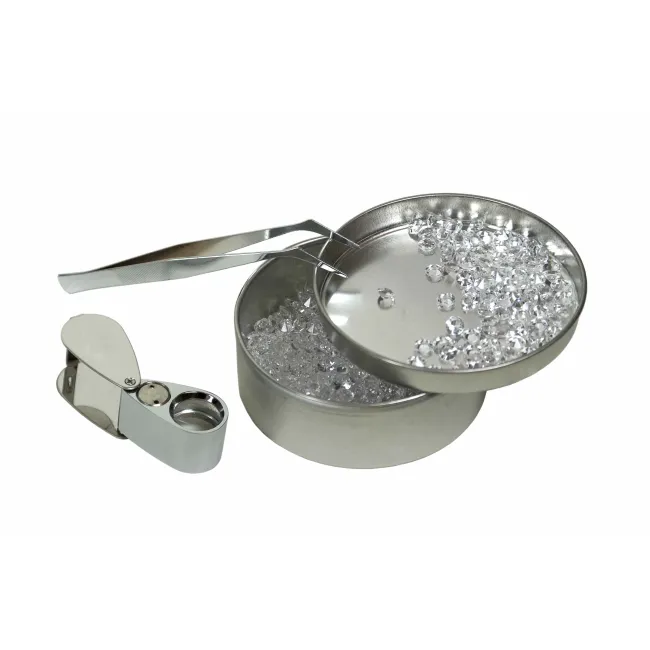
DEFINING RECYCLED DIAMONDS & THEIR VALUE

Recycled diamonds are perhaps the fine jewelry industry's best kept trade secret — presenting a compelling opportunity for jewelry designers and retailers to offer a sustainable, value-retaining alternative to newly mined natural diamonds and lab-grown diamonds.
The broadest definition of a recycled diamond is a natural diamond that was previously owned or manufactured and has re-entered the diamond supply chain to be repurposed for another piece of jewelry. Recycled diamonds are acquired in many ways — from consumer jewelry boxes, estate sales, bankruptcies, and inventory liquidations of collections that may never have made it to market.
HOW WHITE PINE BRINGS RECYCLED DIAMONDS TO MARKET
White Pine buys exclusively from the trade — including pawn shops, retailers, diamond dealers, and diamond manufacturers. Consistency and quality are top priorities for this leading supplier of calibrated recycled diamond melee, breakout and single stones, certified and non-certified, in all shapes, sizes, and qualities.
THE STANDARD WE MAINTAIN
"We categorize our diamonds as Very Good to Excellent makes," says White Pine CEO Benjamin Burne. "The way we maintain this standard is by re-cutting as many of the diamonds we purchase as possible at our factory before putting them into stock. This process allows our customers to receive top quality recycled natural diamonds every time." White Pine's melee program defaults to G/H color with the ability to satisfy requests above or below that grade.
BETTER VALUE THROUGH THE CHAIN
"Diamonds typically pass through many hands — miner, rough dealer, diamond manufacturer, polished dealer, jewelry manufacturer, wholesaler, and retailer — before reaching the public," explains Burne. "Each set of hands marks the diamond up above the commodity price of the raw materials. When buying estate or vintage jewelry, the piece can often be acquired based on the material value, or close to it." White Pine also offers you the chance to sell loose diamonds.
SUSTAINABLE VALUE: WHY RECYCLED DIAMONDS MAKE SENSE
GRADED ON THE SAME SCALE
Recycled diamonds are graded on the same scale as natural diamonds and priced competitively. Historically, the value of natural diamonds has increased over time — unlike lab-grown diamonds, whose prices have declined sharply as production has scaled.
ENDORSED BY THE NDC
The Natural Diamond Council — formed by the world's largest mining companies — endorses recycled diamonds, as the trend only reinforces the value of natural diamonds. NDC CEO David Kellie notes that all projections for diamonds produced from the earth over the next 25 to 40 years will continue to decline, making recycled supply increasingly important.
THE IDEAL RECYCLABLE
Unlike second-hand clothing, handbags, or shoes that degrade over time, diamond — the hardest naturally occurring substance — is the ideal candidate for recycling. It can be reused more than once without any trace of wear. Diamond, after all, is forever.
THE SUSTAINABILITY ADVANTAGE
Recycled diamonds are the most sustainable diamond available — with the lowest ecological impact, as they re-enter the market without requiring a new stone to be mined from the ground or grown in a laboratory. For jewelers, this is a powerful sales advantage with an increasingly sustainability-conscious consumer base.
A GROWING MARKET
Diamond market analyst Paul Zimnisky estimated the diamond resale market at approximately 1–3% of the natural diamond supply annually, or 2 to 4 million carats of rough equivalent — and expects it to grow 3–5% per year. He advocates for a robust diamond resale market as the best way for the trade to demonstrate value and differentiate from lab-created diamonds.
CONSUMER DEMAND IS RISING
Recycled diamonds have grown dramatically in popularity since the pandemic, with many engagement ring shoppers now directly requesting recycled stones. These consumers are more educated, appreciate customization and uniqueness, and want to feel good about their purchases — making recycled diamonds a compelling choice for forward-thinking jewelers.
THE TRADE SECRET WORTH SHARING
"We believe the luxury market needs to focus on sustainable practices, with an emphasis on purchasing pre-owned items already in circulation and selling luxury goods back into the market," says Burne. "Everything we can do to recycle, reuse, and repurpose helps the environment." Recycled diamonds present a ready, ever-growing supply — and jewelers who promote them are positioning themselves at the forefront of where the industry is heading. Browse our recycled diamonds here.
RELATED SERVICES & INVENTORY
Melee Diamonds
Natural and lab-grown melee in trade quantities, sorted and ready to ship.
Learn more →