



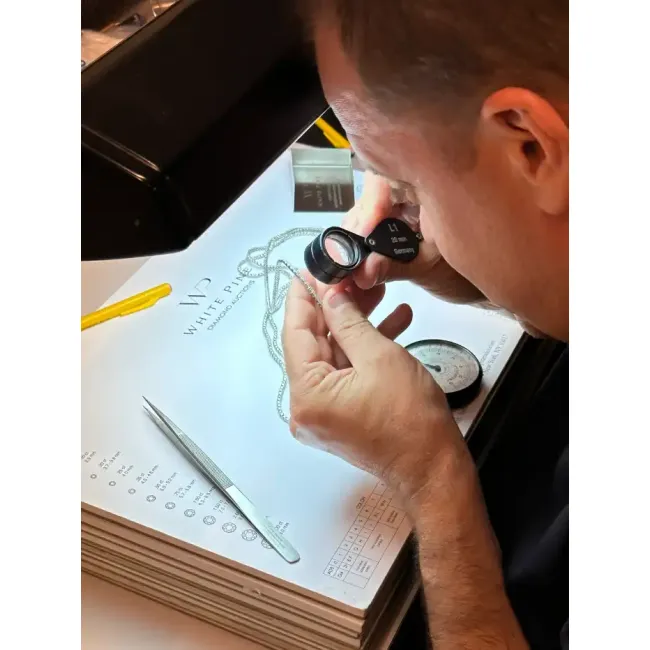
UNDERSTANDING DIAMOND GRADING: WHAT EVERY SELLER NEEDS TO KNOW BEFORE GETTING AN OFFER
By Bill Norton, Vice President of Diamond Operations, White Pine
I've been buying diamonds for a long time. Before I joined White Pine in 2011, I spent years at a midtown Manhattan diamond dealer learning the trade from the inside. I've graded thousands of stones — loose diamonds, estate pieces, engagement rings pulled from drawers after a divorce or an inheritance. What I've noticed is that most people walking in to sell a diamond have no idea how it will be evaluated. That's not a criticism. It's just a gap worth closing.
Here's a straightforward breakdown of how diamond grading works, and what it actually means when you're looking to get a fair offer.
THE FOUR CS — AND WHY THEY ALL MATTER TOGETHER
You've probably heard of the Four Cs: Cut, Color, Clarity, and Carat Weight. Every diamond is evaluated on all four. They don't exist in isolation. A high-carat stone with poor color and heavy inclusions is worth far less than a smaller, well-cut stone with strong grades across the board. Here's what each one means in practice.
Cut refers to how well the diamond has been shaped and faceted to interact with light. This is the C that most directly drives a diamond's brilliance — its sparkle. Cut is graded on a scale from Excellent to Poor. A well-cut diamond returns light through the top of the stone. A poorly cut one lets it leak out the sides or bottom. When I'm evaluating a diamond, cut is often the first thing I look at, because no amount of size compensates for a stone that looks dull.
Color is graded on a scale from D (colorless) to Z (noticeably yellow or brown). Most buyers want diamonds in the colorless to near-colorless range — D through J. Once you get past K, color becomes visible to the naked eye and the value drops accordingly. The distinction between a D and an H can be subtle to most people, but it makes a measurable difference in resale value.
Clarity refers to the presence of inclusions (internal) and blemishes (external). The clarity scale runs from Flawless (FL) down through Very Very Slightly Included (VVS1, VVS2), Very Slightly Included (VS1, VS2), Slightly Included (SI1, SI2), and Included (I1, I2, I3). Most diamonds traded in the secondary market fall in the VS and SI range. Eye-clean SI diamonds — those where inclusions aren't visible without magnification — can still be excellent value. I1 and below get complicated. Heavy inclusions affect durability, not just appearance.
Carat weight is the measurement of a diamond's mass. One carat equals 0.2 grams. The price per carat doesn't increase in a straight line — it jumps at key thresholds. A 1.00ct stone is worth meaningfully more per carat than a 0.95ct stone, even though the visual difference is negligible. Weight is fact; what matters is how that weight is distributed.
GIA CERTIFICATION AND WHAT IT TELLS YOU
The Gemological Institute of America (GIA) is the global standard in diamond grading. I attended GIA's diamond grading school, and the training is rigorous. A GIA grading report is not an appraisal — it's an objective technical document that describes the diamond: its measurements, proportions, cut grade, color grade, clarity grade, and fluorescence. It doesn't tell you what the diamond is worth in today's market. That's a separate conversation.
If you have a GIA certificate with your diamond, that's an asset. It removes the guesswork and speeds up the evaluation process. Other labs — IGI, EGL, AGS — also issue reports, but grading standards vary. In my experience, two identical-looking stones with GIA and EGL reports won't command the same price in the secondary market.
No certificate? That's fine. We grade in-house. It adds a step, but it doesn't prevent us from making a competitive offer.
You can learn more about GIA's grading standards at GIA's official 4Cs guide, and explore how diamonds are valued in the resale market through Rapaport's industry education resources.
FLUORESCENCE AND WHY IT COMES UP
Fluorescence is one of the most misunderstood factors in diamond valuation. It refers to how a diamond responds to UV light. Most fluorescent diamonds glow blue under ultraviolet. In strong daylight, this can either mask yellow color — a positive for lower-color stones — or, in rare cases, make a high-color stone appear slightly hazy. Strong fluorescence in a D-color diamond can reduce its value. In a J-color diamond, it can improve the visual appearance. Context matters. It's not a red flag by default, but it's always factored into the offer.
FREQUENTLY ASKED QUESTIONS
DO I NEED A GIA CERTIFICATE TO SELL MY DIAMOND?
No. A certificate helps establish the grades without re-evaluation and can support value. But if you don't have one, we assess the diamond directly. We grade in-house, and our offers reflect what we determine the stone to be — not what paperwork says it should be.
HOW DOES DIAMOND GRADING AFFECT THE OFFER I RECEIVE?
Directly and significantly. A VS1, G-color, Excellent-cut one-carat round brilliant and an SI2, K-color, Fair-cut stone of the same weight are not comparable in value. The Four Cs and the relationships between them drive the number. When you understand how your diamond grades, you're better positioned to evaluate whether an offer is fair.
WHY DOES MY APPRAISAL VALUE DIFFER FROM THE OFFER I'M GETTING?
Appraisals are typically written for insurance replacement purposes — they reflect retail replacement cost, which is often significantly inflated above market value. The secondary market operates differently. We're buying the diamond at a price that allows us to resell it competitively. Expect a meaningful gap between an insurance appraisal and a buyback offer. That's not unique to White Pine — it's how the secondary market works across the board.
WHAT DIAMONDS HOLD THEIR VALUE BEST?
Round brilliant cuts in the colorless to near-colorless range (D–H), with VS or better clarity, Excellent or Very Good cut grades, and weights at or above major thresholds (0.50ct, 1.00ct, 2.00ct). GIA certification reinforces value. Fancy shapes — ovals, cushions, pears — are subject to more taste-driven fluctuation. Fancy colors (blues, pinks, yellows) are a separate market with different dynamics entirely.
My job isn't to mystify this process. The more you understand about how your diamond will be evaluated, the better the conversation we can have. Straightforward offers. No pressure. No guesswork.
If you have questions before you come in, reach out. I'm happy to talk through it.
— Bill Norton, Vice President of Diamond Operations, White Pine
To get an offer on your diamonds or jewelry - head here.